website

Best Digital Marketer in Ernakulam shows image regarding 10 Digital Marketing Strategies

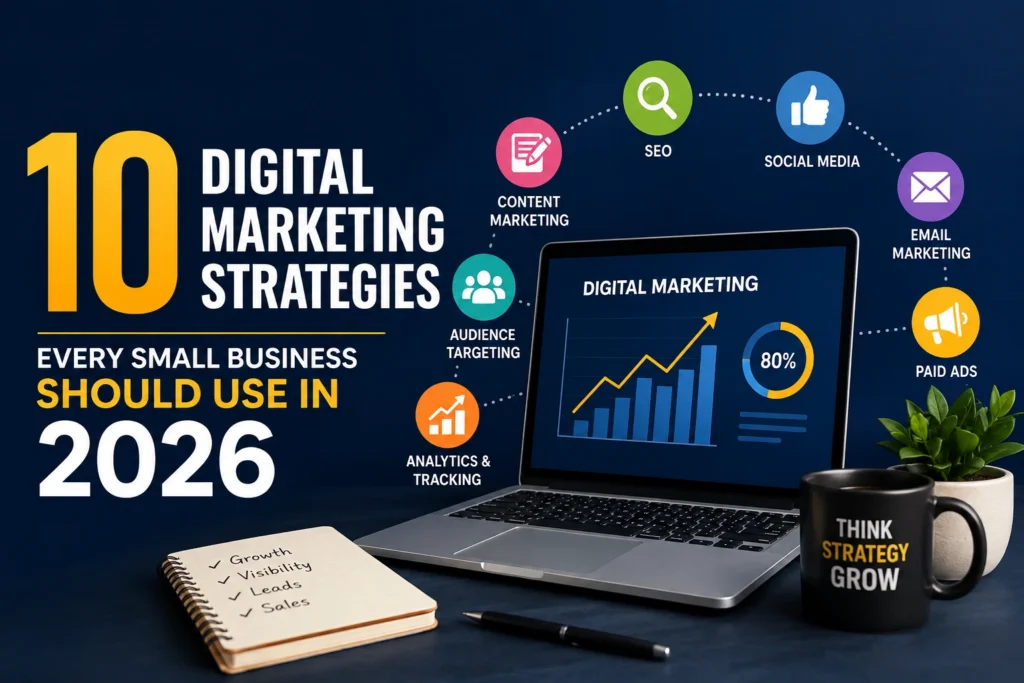
10 Digital Marketing Strategies for Small Businesses in 2026

Introduction In 2026 it is harder than ever for small businesses to stand out in a market that is very crowded. Since customers are now more connected and better informed than they ever have been, they tend to carry out online research and comparisons of products before deciding to buy. Because of this, it is more important than ever to have a solid digital marketing strategy. Digital marketing is able to enable small businesses to compete against larger brands by increasing website traffic, producing leads, and enhancing brand awareness, all at a manageable cost. In this article we are going to examine 10 digital marketing strategies which every small business should be employing in 2026 if they want to improve their online presence and increase their sales. 1. Build a fast, mobile-friendly website. Your website must form the basis of your digital marketing activities. This is usually the first thing that customers encounter when dealing with you, which is why it is important to make a good first impression. Your website should: A well-designed website will not only help make a good impression on customers but also contribute to better search engine rankings. 2. Invest in search engine optimization (SEO) One of the most effective and cost-efficient methods of bringing more traffic to your website is SEO. If you tailor your content to Google, your website will appear in the search results for the appropriate keywords. Even though it may take a while, SEO is a long-term investment which can result in greater traffic and sales. 3.Create Valuable Content Content marketing is an excellent way of educating your customers and gaining their trust. It is possible to produce blog articles, videos, infographics, case studies, tutorials, and other types of content which deal with the questions they have and satisfy their needs. Rather than concentrating only on promoting your products, you should concentrate on providing value. It helps to build trust and establishes your brand as an expert in its area. 4.Use Social Media Marketing Social media is a powerful means of enabling you to get in touch with your audience in a more personal manner. Even though it is important to have a strong presence on social media, it is even more important to concentrate on the platforms that your target audience uses. Some effective social media practices include: Although it is important to post regularly, the quality of your content is more important. A content calendar for social media can help you to stay organized and make sure that you regularly post useful content. 5.Use Video Marketing Platforms such as Instagram Reels, YouTube Shorts, and TikTok are very suitable for small businesses. You can access a large audience without having to spend a lot of money on these platforms. 6. Use artificial intelligence and marketing automation. Marketing automation can help you to save both time and money by taking over repetitive tasks. It can likewise enhance your marketing efforts by giving you insights that you may not have noticed earlier. 7. Improve Your Google Business Profile It is also important to encourage customers to leave reviews. It will help to improve your online reputation and draw in more customers. 8. Develop an email marketing strategy One of the most effective methods of promoting your business is through email marketing.It offers a high return on investment and enables you to establish long-term relationships with your customers.Rather than sending promotional emails, concentrate on adding value by offering educational material, updates about your products, special offers, and other helpful information. It is also important to divide your email list into groups. What this involves is sending messages that are tailored to various groups of customers, thereby increasing the likelihood of higher open and click-through rates. 9.Measure Your Results It is important to keep an eye on your marketing results if you want to know which actions are working and which ones need improving.It enables you to arrive at better decisions regarding your budget and strategy. Some key metrics to track include: You can spot areas where you need to make improvements and then make the appropriate changes to your marketing strategy by looking at these metrics. 10.Focus on building customer trust. One of a business’s most valuable assets is the trust of its customers. This is what causes customers to come back to your business and to recommend it to other people. Trust should therefore be a top priority for any small business. Conclusion In 2026 digital marketing is based on innovation, a focus on the customer experience, and making decisions on the basis of data. Small businesses do not any longer have to rely on huge marketing budgets if they want to compete; what they need instead are intelligent strategies and consistent implementation. Begin by setting up a solid website, put effort into SEO, produce useful content, make use of social media, welcome the use of AI, and keep on measuring your results. Each improvement, regardless of how small it may be, will help achieve long-term success. Keep in mind that digital marketing is not a single-time thing; it is an continuous process involving learning, adapting, and making improvements. Companies which stay flexible and keep the customer in mind will keep on growing, attract loyal customers, and distinguish themselves in the current competitive digital environment. Now is the ideal time to enhance your digital marketing strategy. Begin putting into practice these proven techniques so that your small business can achieve sustainable growth throughout 2026 and beyond. FAQs 1. In 2026, which digital marketing tactics will be most popular for small businesses? People who use SEO, social media marketing, content marketing, email marketing, local SEO, paid ads, video marketing, working with influencers, optimizing websites, and collaborating with them are the best at digital marketing. 2. Why is it important for small businesses in 2026 to use internet marketing? Digital marketing allows small businesses to reach their target audience, boost their online visibility, attract potential customers, build up trust, and increase their

10 Digital Marketing Strategies for Small Businesses in 2026 Read Post »
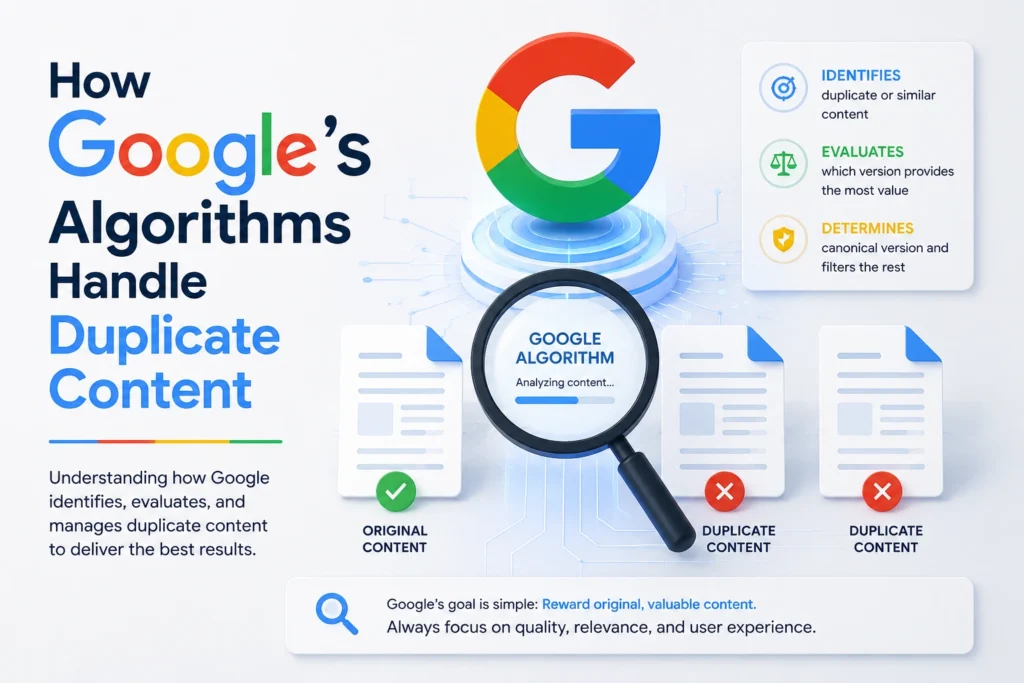
Best Digital Marketer in Ernakulam shows image regarding Google algorithms

How Google’s Algorithms Handle Duplicate Content

Introduction Duplicate content is a common topic that people often misunderstand when it comes to SEO.Many website owners worry that having similar or repeated content will directly lead to a Google penalty.However, duplicate content usually does not result in a direct ranking penalty.Instead, Google’s algorithm looks for similar pages and decides which one is the most helpful and relevant for users. Duplicate content can happen naturally. For example, an e-commerce site might have multiple URLs showing the same product, or a blog may have a printer-friendly version of the same article.It can also occur when websites Use URL parameters, republish articles, or make distinct pages for comparable services. Understanding how Google deals with duplicate content can help website owners organize their site better, make it easier for search engines to crawl and index, and ensure the right pages appear in search results. What is duplicate content? Duplicate content means the same or very similar content appears on more than one URL. These URLs can be on the same website or different websites. For example, imagine a website has these two URLs: example.com/digital-marketing example.com/services?category=digital-marketing If both pages have about the same information, Google may see them as duplicate or near-duplicate pages. Duplicate content can be intentional or unintentional. Common examples include product variations, syndicated articles, HTTP vs.HTTPS versions, www vs.non-www versions, URL parameters, print versions, and content accessible through different URLs. It’s important to know that having similar content isn’t always a problem. Google focuses on helping users find the most relevant version, not punishing websites for having repeated information. How does Google identify duplicate content? Google uses automated tools to crawl and analyze web pages. When it finds multiple pages with similar content, it recognizes that they might be the same or closely related information. Google may then pick one URL from the group of duplicates as the main or representative page. This is the version Google thinks is most suitable for showing in search results. Several factors can influence this choice, including: These signals help Google decide which URL should be treated as the main version. Does duplicate content cause a Google penalty? This is one of the biggest misunderstandings about duplicate content. Having duplicate content typically does not lead to a direct Google penalty. Instead, Google might hide similar pages from its search results and choose the one it thinks is most useful. For example, if five URLs have almost the same information, Google doesn’t have to show all five. It might pick one and not show the others. However, duplicate content can still cause SEO issues. If your website has many unnecessary duplicate URLs, search engines may waste time crawling pages that don’t add much value.Duplicate pages can also confuse Google about which version you want to be indexed. So, while duplicate content isn’t usually a penalty, managing it properly is important for good SEO. Common causes of duplicate content Duplicate content can be produced in a number of ways. 1. Multiple URL versions A website might accidentally make the same page accessible through different URLs. For example, HTTP and HTTPS versions or URLs with and without trailing slashes can sometimes create duplicate content. 2. URL parameters E-commerce sites and large websites often use URL parameters for filtering, sorting, tracking, or navigation. These parameters can create multiple URLs that contain the same main content. 3. Product variations An online store might create separate URLs for different colors or sizes of the same product. If these pages have almost the same information, Google might treat them as duplicates. 4. Content syndication A blog article might be published on multiple websites. If another website republishes your article, Google might see similar versions across different domains. 5.Printer-friendly or mobile pages Some websites create separate URLs for printer-friendly or mobile versions of the same page. If these versions have the same content, they can create unnecessary duplication. How Canonical Tags Help A canonical tag is a very helpful tool for dealing with duplicate or similar web pages. The canonical tag lets search engines know which page should be considered the main or most important version when there are similar pages. For example, if there are several product pages with the same information, you can mark one as the main page using a canonical tag. However, a canonical tag is just a hint, not an order. Google uses it along with other factors to decide which page to show in search results. Website owners should make sure their canonical tags are correct, used consistently, and point to pages that are easy to access. Other Ways to Handle Duplicate Content Canonical tags are not the only way to handle duplicate content. Use redirects: If a page has moved permanently to a new URL, a redirect can help send both visitors and search engines to the correct page. Improve internal linking: Always link to the main page you want to be considered important. This helps Google understand which page to prioritize. Keep URLs simple: Avoid creating too many different versions of the same page through unnecessary URL structures. Use consistent sitemaps: List only the main pages you want Google to find and take into account for indexing. Create unique content: If pages are meant for different searches, make sure the content is truly useful and different rather than just changing a few words. Even if duplicate content doesn’t cause a penalty, creating original and helpful content is still very important.            Imagine a business has ten service pages that are almost exactly the same, with only the city names changed. Google might see these as not providing much extra value. Each page should offer real information that is relevant to its specific audience, location, or service. Including original examples, practical advice, customer questions, expert opinions, and other useful details can make pages more valuable. The goal isn’t just to make every page different for the sake of being different. The goal is to make each important page helpful enough to appear in search results.

How Google’s Algorithms Handle Duplicate Content Read Post »

Best Digital Marketer in Ernakulam shows image regarding how Genz engages in today' market

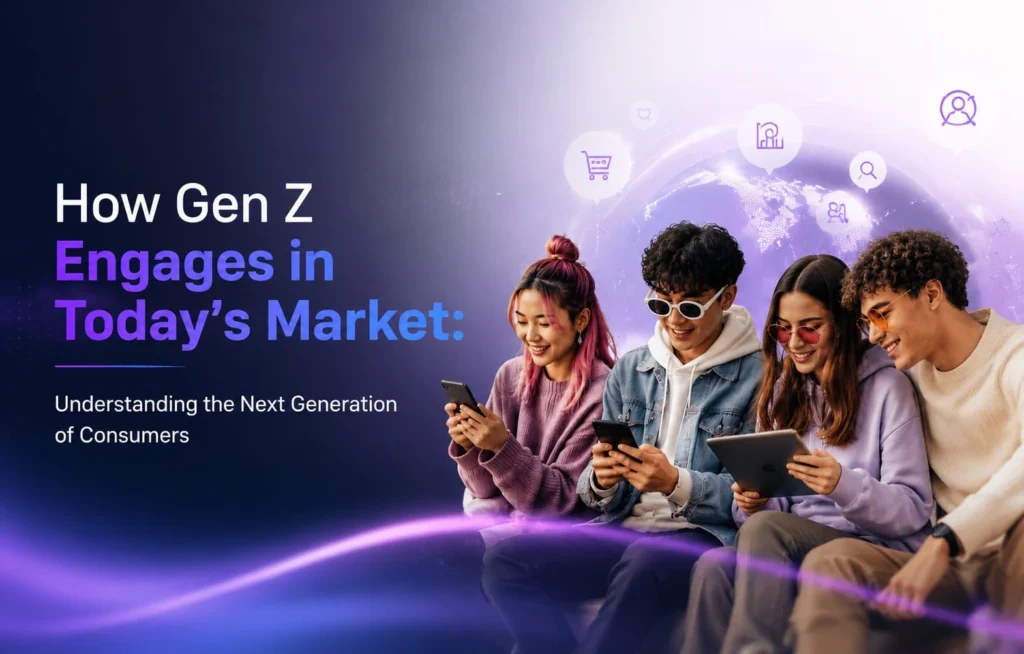
How Gen Z Engages in Today’s Market

Today’s Introduction Generation Z, commonly known as Gen Z, includes individuals born between the mid-1990s and early 2010s. As digital natives, they have grown up with smartphones, social media, and instant access to information. Their buying habits, communication styles, and expectations differ significantly from previous generations, making them one of the most influential consumer groups in today’s market. Businesses that understand how Gen Z engages with brands can build stronger relationships, increase customer loyalty, and drive long-term growth. A Digital-First Generation Gen Z spends a significant portion of their day online, making digital platforms the primary channel for discovering products and services. Instead of relying on traditional advertisements, they explore brands through social media, search engines, video content, and online reviews. Platforms like Instagram, TikTok, YouTube, and Snapchat influence their purchasing decisions by showcasing trends, product demonstrations, and authentic user experiences. This generation values convenience and expects brands to provide seamless digital experiences across websites, mobile apps, and social media channels. Authenticity Builds Trust Unlike previous generations, Gen Z is highly selective about the brands they support. They value authenticity over polished advertising and prefer businesses that communicate honestly and transparently. Consumers in this generation appreciate brands that share real stories, showcase behind-the-scenes content, and engage directly with their audience. They are also more likely to trust recommendations from content creators, influencers, and everyday customers than traditional celebrity endorsements. User-generated content, customer testimonials, and genuine reviews often have a greater impact than expensive advertising campaigns. Social Media Shapes Buying Decisions Social media is more than just entertainment for Gen Z—it is a powerful shopping and discovery platform. Short-form videos, live streams, interactive polls, and product reviews help them evaluate products before making a purchase. Viral trends and influencer collaborations can significantly increase a product’s popularity within a short period. Brands that actively engage with followers by responding to comments, creating interactive content, and participating in online conversations are more likely to build lasting relationships with Gen Z consumers. Purpose Matters More Than Price While affordability remains important, Gen Z often considers a brand’s values before making a purchase. They support businesses that demonstrate social responsibility, environmental sustainability, diversity, and ethical business practices. Companies that actively contribute to positive social change and communicate their values clearly are more likely to earn the trust of this generation. Gen Z expects brands to take meaningful action rather than simply making marketing claims. Authentic commitment to social and environmental issues plays a significant role in influencing their purchasing decisions. Personalized and Interactive Experiences Gen Z expects personalized experiences throughout their customer journey. They appreciate tailored product recommendations, customized offers, and relevant content based on their interests and browsing behavior. Interactive experiences such as quizzes, augmented reality filters, gamified shopping, and AI-powered customer support also enhance engagement and create memorable brand interactions. Businesses that combine technology with personalization can deliver experiences that keep Gen Z interested and encourage repeat purchases. Conclusion Gen Z is reshaping today’s market with its digital-first mindset, demand for authenticity, and preference for meaningful brand experiences. They expect businesses to communicate transparently, embrace innovation, and align with values that matter to them. Companies that invest in engaging digital content, personalized experiences, and genuine customer relationships will be better positioned to connect with this influential generation. As Gen Z’s purchasing power continues to grow, understanding their behavior is no longer optional—it is essential for success in the modern marketplace.

How Gen Z Engages in Today’s Market Read Post »

Best Digital Marketer in Ernakulam shows image regarding how social media marketing helps businesses

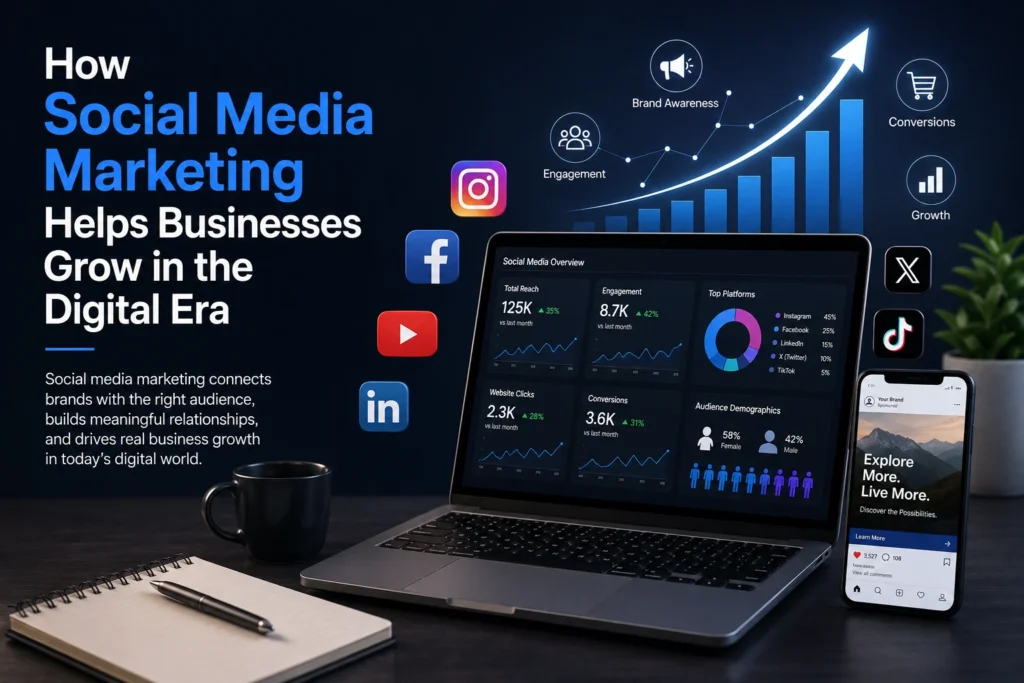
How Social Media Marketing Helps Businesses Grow

Introduction In today’s digital-first world, businesses are no longer limited to traditional marketing methods. Customers spend a significant amount of their time on social media platforms, making these channels powerful tools for brands to connect, engage, and grow. Social media marketing has become an essential strategy that helps businesses increase brand awareness, build customer relationships, and achieve long-term growth. From small startups to global companies, businesses are using social media to reach their target audience, understand customer needs, and create meaningful brand experiences. What Is Social Media Marketing ? Social media marketing is the process of promoting products, services, or brands through platforms such as Instagram, Facebook, LinkedIn, YouTube, and other digital channels. It involves creating valuable content, engaging with audiences, running advertisements, and analyzing performance to achieve marketing goals. Unlike traditional advertising, social media allows businesses to communicate directly with customers and create two-way conversations. One of the biggest advantages of social media marketing is its ability to increase brand visibility. Businesses can showcase their products, services, values, and stories to millions of potential customers. Through consistent posting, engaging visuals, videos, and informative content, brands can create recognition and stay connected with their audience. For example, a small business can use Instagram Reels or Facebook content to reach customers beyond its local area without spending a large amount on traditional advertising. Modern customers prefer brands that interact with them and understand their needs. Social media provides businesses with an opportunity to communicate directly with their audience through comments, messages, polls, and live sessions. By responding to customer questions and feedback, businesses can create trust and develop stronger relationships. A brand that actively engages with its audience feels more authentic and customer-focused. Social media platforms provide advanced targeting options that allow businesses to reach specific groups based on: Paid social media advertising helps businesses deliver their message to people who are more likely to become customers, improving marketing efficiency and reducing wasted spending. Social media is a powerful source of website traffic and conversions. Businesses can use social platforms to promote: With effective content strategies and clear calls-to-action, social media followers can be converted into website visitors and paying customers. Customers often research a brand online before making purchasing decisions. A professional and active social media presence helps businesses establish credibility. Sharing customer reviews, behind-the-scenes content, educational posts, and success stories can increase trust and influence buying decisions. Today, a strong social media presence acts as a digital reputation for businesses. Social media platforms provide valuable data about customer behavior and preferences. Businesses can analyze: These insights help businesses improve their marketing strategies and create content that better matches customer expectations. Compared to traditional marketing methods, social media marketing can be more affordable and accessible, especially for small businesses. Businesses can start building an audience organically through valuable content and later invest in paid advertising to increase their reach. This makes social media marketing a flexible solution for businesses of all sizes. The digital marketplace is highly competitive. Businesses that actively use social media have a better chance of staying visible and relevant. By following trends, creating engaging content, and adapting to customer behavior, brands can maintain a strong position in their industry. Conclusion Social media marketing has transformed the way businesses connect with customers. It provides opportunities to increase brand awareness, build relationships, generate leads, and drive business growth. In the digital era, businesses that understand the power of social media and use it strategically can create stronger brands and achieve sustainable success. A well-planned social media marketing strategy is no longer optional — it is a key part of building a successful modern business.

How Social Media Marketing Helps Businesses Grow Read Post »

Best Digital Marketer in Ernakulam shows image regarding today's marketing

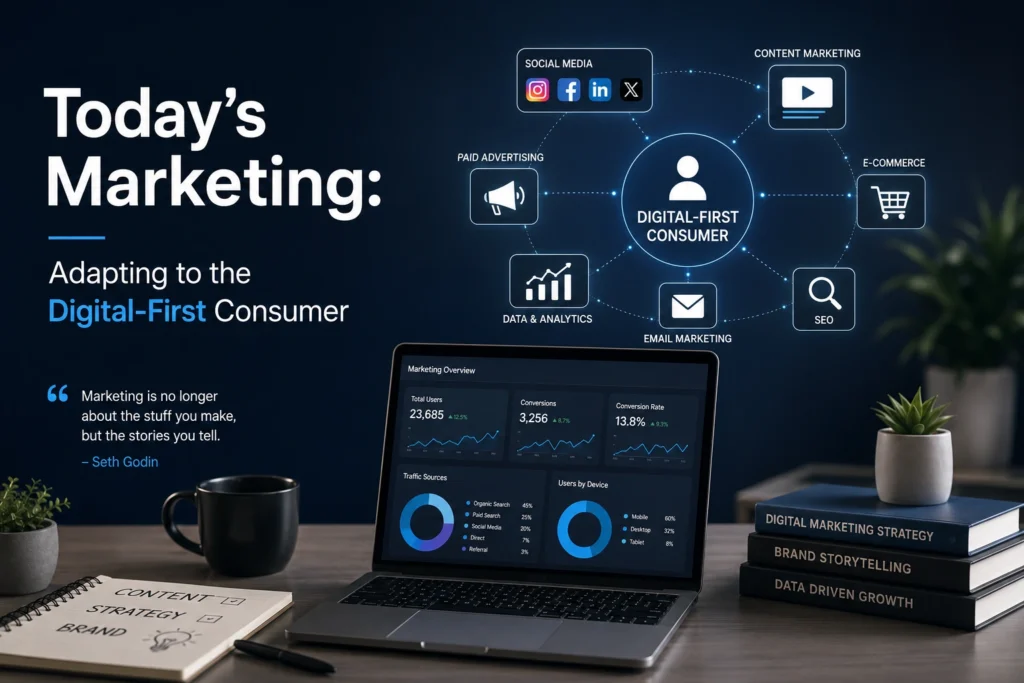
Today’s Marketing: Adapting to the Digital-First Consumer

Introduction Over the last ten years, marketing has changed greatly as a result of rapid technological progress and shifts in the way consumers behave. Nowadays, consumers are more connected, informed, and selective than at any time in the past. They are able to find products on social media, check prices on the internet, read reviews, watch videos, and communicate directly with brands all before making a purchase. Consequently, marketing is not confined to television, newspapers, radio, or billboards any more. In order to succeed nowadays, companies have to use digital platforms, adopt data-driven strategies, offer personalised experiences, provide valuable content, and establish strong customer relationships. Today’s marketing consists of reaching the correct audience, adding value, building trust, and guiding customers along their buying journey. The Rise of Digital Marketing Digital marketing is now a major factor in the way modern businesses achieve growth. Consumers spend a great deal of time using search engines, social media, websites, email, and mobile applications. The various platforms offer businesses the chance to target specific audiences according to their interests, behaviour, demographic characteristics, and location. Businesses can more effectively communicate with potential customers through the use of search engine optimization (SEO), search engine marketing (SEM), social media marketing, email marketing, content marketing, and online advertising. A major benefit of digital marketing is that it is measurable. It is possible to monitor website traffic, engagement, leads, conversions, and the performance of campaigns. The information obtained allows companies to see what is working and to make improved marketing decisions. Customer-Centric Marketing The marketing carried out today places a strong emphasis on the customer. It is no longer enough just to promote products; businesses must come to know their customers’ problems, expectations, interests, and the way they behave when making purchases. A strategy that is customer-focused raises several important questions: What are the customer’s needs? What problem are they attempting to solve? What information do they require before making a purchase? On which platforms do they use them? If businesses understand these factors they can then produce messages and experiences that are relevant. Customers are more likely to engage with a brand and become loyal over the long term when they feel that they have been understood. Personalization Is the Key to Success People now expect personalised experiences, and companies can make use of customer data and their online behaviour to give out relevant content, recommendations, and offers. For instance, an e-commerce website can make product recommendations on the basis of past purchases or the websites that have been browsed. In a similar way, email campaigns can be tailored to match customer interests. Personalization has the advantage of increasing engagement and customer satisfaction; yet companies must use customer information responsibly and make it clear how data is collected and used. The Power of Social Media Marketing Social media has changed the way businesses communicate with their customers. Nowadays, companies can form communities and get in direct contact with their audiences through platforms like Instagram, Facebook, LinkedIn, TikTok, and YouTube. Businesses make use of social media in order to boost their brand awareness, give customers information, display their products, respond to questions, gather feedback, and obtain leads. Short-form videos, reels, live streams, educational posts, and user-generated content have all become important ways of attracting attention, so social media is no longer merely an advertising channel; it has also become a platform for building relationships. Content Marketing Builds Trust Content marketing is about giving an audience useful and valuable information, and blogs, videos, podcasts, guides, infographics, newsletters, and case studies all help companies to show their expertise. For instance, a real estate company could produce content on home-buying advice, mistakes to avoid when investing in property, and the various factors that should be taken into account before buying a house. The content offers value at the same time as establishing the business as a knowledgeable source. Content that is consistent and of high quality can also help improve search visibility, draw in organic traffic, and ensure that customers remain connected with the brand. The Growth of Video Marketing Video is now one of the most engaging types of digital content and companies can use it to show their products, explain their services, respond to questions, publish testimonials, and share the stories of their brand. Short-form videos are especially useful for grabbing people’s attention at once, but longer educational videos too can assist businesses in explaining complicated subjects and establishing their authority. A good video strategy should be based on offering value rather than just promoting a product. Artificial Intelligence and Automation Artificial intelligence is today having a major impact on marketing by enabling companies to work more efficiently. Tools driven by AI can assist with coming up with content ideas, dividing customers into segments, carrying out data analysis, using predictive analytics, providing chatbot services, and improving campaigns. Marketing automation is also capable of dealing with routine tasks such as email sequences, social media scheduling, and the nurturing of leads. AI should instead support human creativity and strategic thinking rather than entirely replace it, and authenticity, storytelling, emotional understanding, and creative decision-making should still be important for successful marketing. Data-Driven Marketing Data has now become a vital basis for marketing decisions; rather than depending completely on assumptions, companies can make use of performance data in order to find out what their customers respond to. Important marketing metrics are website traffic, engagement rate, conversion rate, customer acquisition cost, return on advertising spend, click-through rate, and lead generation. By examining these metrics businesses are able to spot which of their campaigns have been successful, improve their weak points, and make more effective use of their marketing budgets. Omnichannel Marketing and Customer Experience Customers frequently interact with companies on a number of different platforms. For example, a customer might first come across a brand on Instagram, then look for its website on Google, read the online reviews, and finally make the purchase via the website. The objective of omnichannel marketing is to ensure

Today’s Marketing: Adapting to the Digital-First Consumer Read Post »

Scroll to Top