
Introduction
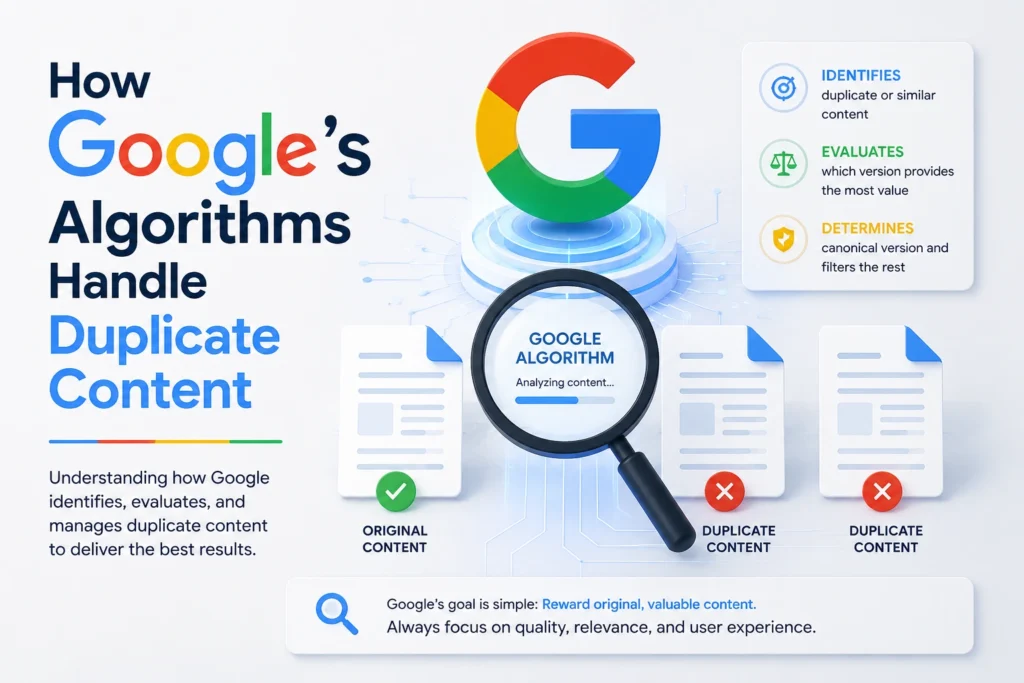
Duplicate content is a common topic that people often misunderstand when it comes to SEO.Many website owners worry that having similar or repeated content will directly lead to a Google penalty.However, duplicate content usually does not result in a direct ranking penalty.Instead, Google’s algorithm looks for similar pages and decides which one is the most helpful and relevant for users.
Duplicate content can happen naturally. For example, an e-commerce site might have multiple URLs showing the same product, or a blog may have a printer-friendly version of the same article.It can also occur when websites Use URL parameters, republish articles, or make distinct pages for comparable services.
Understanding how Google deals with duplicate content can help website owners organize their site better, make it easier for search engines to crawl and index, and ensure the right pages appear in search results.
What is duplicate content?
Duplicate content means the same or very similar content appears on more than one URL. These URLs can be on the same website or different websites.
For example, imagine a website has these two URLs:
example.com/digital-marketing
example.com/services?category=digital-marketing
If both pages have about the same information, Google may see them as duplicate or near-duplicate pages.
Duplicate content can be intentional or unintentional. Common examples include product variations, syndicated articles, HTTP vs.HTTPS versions, www vs.non-www versions, URL parameters, print versions, and content accessible through different URLs.
It’s important to know that having similar content isn’t always a problem. Google focuses on helping users find the most relevant version, not punishing websites for having repeated information.
How does Google identify duplicate content?
Google uses automated tools to crawl and analyze web pages. When it finds multiple pages with similar content, it recognizes that they might be the same or closely related information.
Google may then pick one URL from the group of duplicates as the main or representative page. This is the version Google thinks is most suitable for showing in search results.
Several factors can influence this choice, including:
- – The canonical tag set by the website
- – Internal links pointing to a specific URL
- – Redirects
- – Sitemap signals
- – Preference for HTTPS
- – Website structure
- – Each page’s content and applicability
These signals help Google decide which URL should be treated as the main version.
Does duplicate content cause a Google penalty?
This is one of the biggest misunderstandings about duplicate content. Having duplicate content typically does not lead to a direct Google penalty. Instead, Google might hide similar pages from its search results and choose the one it thinks is most useful.
For example, if five URLs have almost the same information, Google doesn’t have to show all five. It might pick one and not show the others. However, duplicate content can still cause SEO issues.
If your website has many unnecessary duplicate URLs, search engines may waste time crawling pages that don’t add much value.Duplicate pages can also confuse Google about which version you want to be indexed.
So, while duplicate content isn’t usually a penalty, managing it properly is important for good SEO. Common causes of duplicate content Duplicate content can be produced in a number of ways.
1. Multiple URL versions
A website might accidentally make the same page accessible through different URLs. For example, HTTP and HTTPS versions or URLs with and without trailing slashes can sometimes create duplicate content.
2. URL parameters
E-commerce sites and large websites often use URL parameters for filtering, sorting, tracking, or navigation. These parameters can create multiple URLs that contain the same main content.
3. Product variations
An online store might create separate URLs for different colors or sizes of the same product. If these pages have almost the same information, Google might treat them as duplicates.
4. Content syndication
A blog article might be published on multiple websites. If another website republishes your article, Google might see similar versions across different domains.
5.Printer-friendly or mobile pages
Some websites create separate URLs for printer-friendly or mobile versions of the same page. If these versions have the same content, they can create unnecessary duplication.
How Canonical Tags Help
A canonical tag is a very helpful tool for dealing with duplicate or similar web pages. The canonical tag lets search engines know which page should be considered the main or most important version when there are similar pages.
For example, if there are several product pages with the same information, you can mark one as the main page using a canonical tag. However, a canonical tag is just a hint, not an order.
Google uses it along with other factors to decide which page to show in search results. Website owners should make sure their canonical tags are correct, used consistently, and point to pages that are easy to access.
Other Ways to Handle Duplicate Content
Canonical tags are not the only way to handle duplicate content.
Use redirects: If a page has moved permanently to a new URL, a redirect can help send both visitors and search engines to the correct page.
Improve internal linking: Always link to the main page you want to be considered important. This helps Google understand which page to prioritize.
Keep URLs simple: Avoid creating too many different versions of the same page through unnecessary URL structures. Use consistent sitemaps: List only the main pages you want Google to find and take into account for indexing.
Create unique content: If pages are meant for different searches, make sure the content is truly useful and different rather than just changing a few words. Even if duplicate content doesn’t cause a penalty, creating original and helpful content is still very important.
Imagine a business has ten service pages that are almost exactly the same, with only the city names changed. Google might see these as not providing much extra value. Each page should offer real information that is relevant to its specific audience, location, or service.
Including original examples, practical advice, customer questions, expert opinions, and other useful details can make pages more valuable. The goal isn’t just to make every page different for the sake of being different. The goal is to make each important page helpful enough to appear in search results.
FAQs
1.Does Google punish websites for having duplicate content?
Not usually. Duplicate content doesn’t automatically lead to a penalty.Google may choose one version of similar pages to show in search results.
2.Is duplicate content bad for SEO?
It can cause SEO issues, especially if many pages have the same information. It can make crawling, indexing, and determining the main page more difficult.
3.What is a canonical URL?
A canonical URL is the main version of a page when there are several similar URLs.
4.Can I publish my blog posts on another site?
Yes, you can share content, but it’s important to know search engines might choose one version as the main result. You can use canonical tags or other signals to show which is the original.
5.Should every page on my website have unique content?
Important pages should offer value and match what users are looking for. Not every small section needs to be completely different, but pages should avoid unnecessary repeats.
Conclusion
Google’s approach to duplicate content is about making search results useful and organized, not punishing websites automatically. When Google finds similar pages, its systems can group them and choose one based on different signals. For website owners, the best approach is to keep your site structure clear, use canonical tags properly, redirect outdated pages, create consistent internal links, and develop truly helpful content.
Duplicate content alone shouldn’t cause worry. Treat it as part of SEO management.By helping Google know which pages are important and making sure your content helps users, you can build a website that is easier to find and use through search.